BC Separation Agreement: Questions to Work Through (2026 Guide)
A practical guide to disclosure, independent legal advice, signing, and witness questions before a final separation agreement.
Choose your family-law next step
Separating: what should I prepare?
Start a timeline and list the decisions still open: parenting, support, property or debt. Gather any existing orders or agreements. Our guide helps you organize those questions; it does not offer a paid separation agreement.
Family Law in BC: preparing an agreementParenting or support: where do I start?
Note the child’s routine, any current parenting arrangements or orders, and what needs to change. For child support, use Justice Canada’s tables for the relevant period as a starting point; a table amount is not always the final amount.
Justice Canada: choose the child support tables for your period Province of BC: find family justice servicesHave a draft agreement? Get it reviewed.
Mark any term you don’t understand, and bring the draft, related financial records and any deadlines to your own lawyer. Ask what independent advice or a limited-scope review would cover. Don’t enter sensitive case details in a directory search.
Family Law in BC: independent legal adviceFind a family lawyer
These are recorded listings, not recommendations or confirmed appointments. Ask the provider whether they handle your specific issue, have availability, and what a first consultation costs.
Find family-law help by cityThis product is not currently available for new checkout. Review the recorded scope and exclusions; use Family Law matching if you need help with your arrangements.
Find family-law legal help Review separation-agreement product information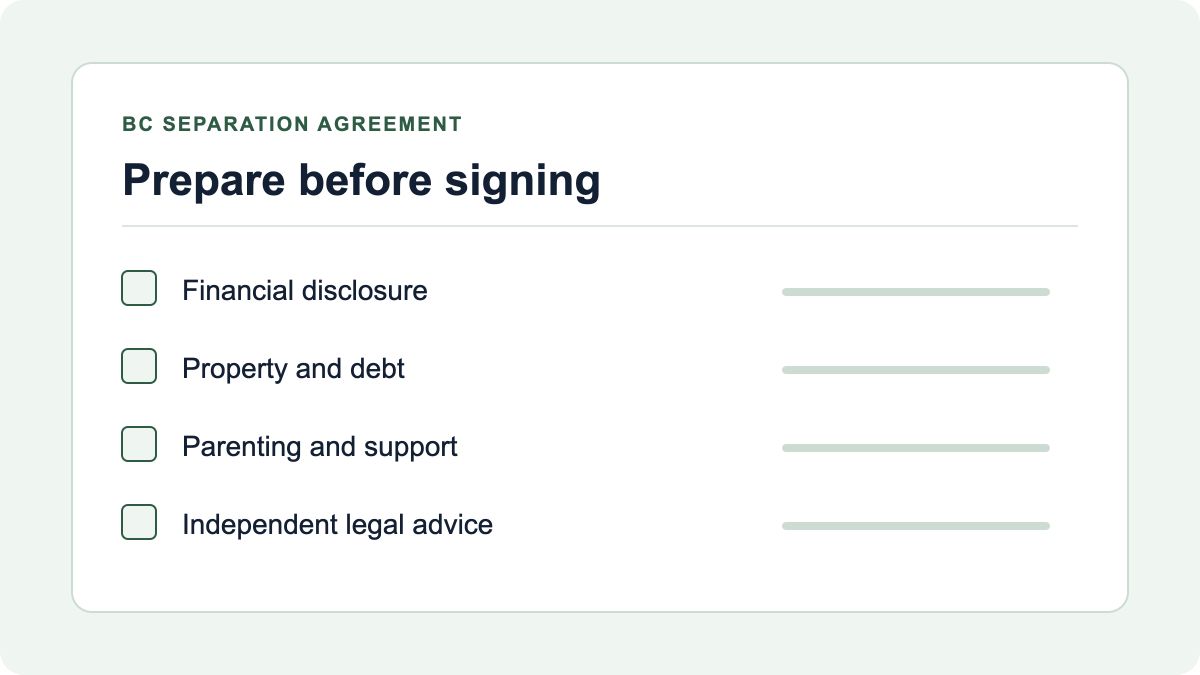
A separation agreement can help people record arrangements after they separate. This general information identifies common questions to organize before anyone treats terms as final; it does not decide what is fair, valid, or suitable for a particular family.
Does a BC separation agreement need to be notarized?
Generally, no: a BC separation agreement does not need to be notarized merely to sign it. Clicklaw’s current execution guidance says it is not necessary to pay a lawyer or notary public to serve as a witness. Signing with an adult witness and independent legal advice are separate matters; additional documents or transactions can have their own formalities. Neither a notarial act nor a working template guarantees that an agreement is suitable or effective for a particular family.
Start with the issues and records that may need discussion
Depending on the family, discussions may involve parenting, child support, spousal support, property, debt, the family home, insurance, pensions, and future review points. Make a list of the topics, records, and unresolved questions rather than assuming a standard clause fits every situation.
Exchange relevant financial information before finalizing terms
Financial disclosure can matter when people are discussing property, debt, or support. Keep original statements and records, identify what information is missing, and ask for advice before relying on an incomplete picture. The Family Law Act and current family-law guidance should be checked for the circumstances at issue.
Keep parenting and support questions specific
Where children are involved, record the practical questions that need to be resolved: routines, communication, decision-making, expenses, support, and how changes will be handled. Do not assume a generic schedule or support figure is appropriate without current information and, where needed, tailored advice.
Signing, adult witnesses, and independent legal advice
Before anyone signs, use current official guidance to check the writing, signing, and adult-witness requirements that apply to the agreement. Independent legal advice can help each person understand the proposed terms and the consequences of signing. It is particularly important to pause where there is pressure, missing information, safety concerns, a major power imbalance, or a disagreement about a material issue.
When a working template may not be enough
A working template can help organize agreed information in a straightforward situation. It is not a substitute for advice, negotiation, representation, a calculation, a filing service, or a guarantee that terms will be effective. Seek tailored legal help before signing where the circumstances are complex, disputed, urgent, cross-border, or safety-related.
Do not rush a final agreement to meet an informal deadline. Keep the source records, identify missing disclosure, and obtain appropriate advice before signing if the consequences are material.
Questions and answers
Does a separation agreement need to be notarized in BC?
Generally, no: a BC separation agreement does not need to be notarized merely to sign it. Signing with an adult witness and independent legal advice are separate matters; additional documents or transactions can have their own formalities. Current execution guidance is linked below. This does not guarantee that terms are suitable or effective for a particular family.
Can I start with a separation-agreement working template?
A working template can help organize information and questions already discussed. It does not determine appropriate terms, replace disclosure or independent legal advice, or resolve disputes between the parties.
When should I seek legal help before signing?
Seek tailored help where there is pressure, missing or disputed financial information, a parenting disagreement, a significant property or debt issue, safety concerns, or uncertainty about the consequences of the proposed terms.
Sources and further information
- Family Law in BC — Making an agreement after separation
- Family Law in BC — Making an agreement after separation
- Family Law in BC — Separation guide conclusion
- BC Laws — Family Law Act
- Clicklaw — How Do I Execute a Family Law Agreement?